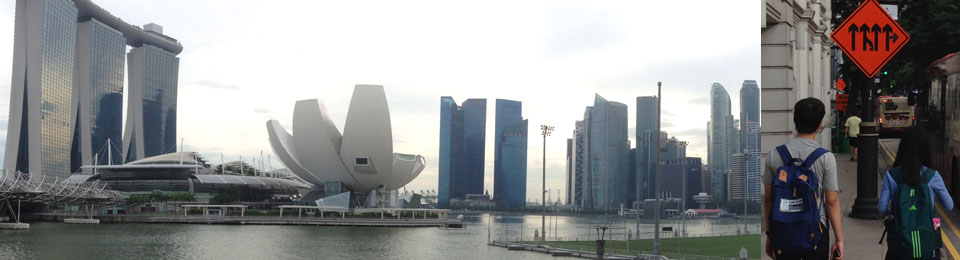
Singaporean Courtesy on a Trip to the Starbucks at Plaza Singapura Mall in Singapore
An internet search on Singapore would likely paint a portrait of the country in broad strokes, like the facts that Singapore is comprised of a set of islands in Southeast Asia, has been an independent nation since separating from Malaysia in 1965, and is comprised primarily of people of Chinese, Indian, and Malay ethnic ancestry (for example, see the About.com article on Singaporean history available at http://app.singapore.sg/about-singapore/history/early-history for a quick popular overview). For my first regular post of 2015, however, I would like to highlight a finer detail of Singaporean life that I did not see mentioned in any travel guide before my arrival here–namely, simple Singaporean courtesy at the cash register.
After arriving here in Singapore, I soon noticed that virtually every time a cashier handed me a monetary note in change or a receipt from a purchase, he or she did so with both hands (while saying “thank you”). Curious about the reason that the majority of cashiers in Singapore used both hands to return bills or receipts while American cashiers generally use only one hand to do the same thing, I asked a young lady who is Singaporean and ethnically Indian why she used both hands. She smiled at my asking something that seemed so obvious to her, but eventually told me that using both hands to hand over bills or receipts was more polite in her estimation, and she does it to be courteous to each customer she serves. She is not alone. I noticed the same thing with cashiers young and not-so-young, as well as across ethnic lines. Sometimes the two-handed return of cash or a receipt is accompanied by a slight bow of the head to add an additional note of politeness. When people exchange business cards here, they follow a similar approach, turning the business card toward the recipient, holding the two closest corners while handing it over, and slightly bowing the head. The recipient then receives the business card with both hands, and takes a moment to read it carefully before continuing the conversation. Across the rich ethnic mix of contemporary Singapore, this simple and ubiquitous extra touch of politeness in the daily routine of my smiling young Indian-Singaporean friend seems to be, well, Singaporean.
I cannot pretend to have the historical or cultural insight necessary to pinpoint the source of this view on courtesy at the cash register in the hustle-bustle of very modern and commercial Singaporean daily life, but perhaps my lack of prior exposure to Singapore is not such a bad thing. The Fulbright program’s core mission is to promote mutual understanding, just as the official site for the Fulbright U.S. Student program states:
“The program facilitates cultural exchange through direct interaction on an individual basis in the classroom, field, home, and in routine tasks, allowing the grantee to gain an appreciation of others’ viewpoints and beliefs, the way they do things, and the way they think. Through engagement in the community, the individual will interact with [his or her] hosts on a one-to-one basis in an atmosphere of openness, academic integrity, and intellectual freedom, thereby promoting mutual understanding” (http://us.fulbrightonline.org/about/fulbright-us-student-program).
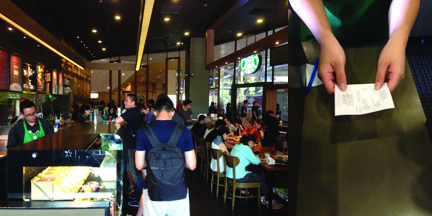
Having arrived here in Singapore with a professional background in international law and arbitration and no formal educational experience with Singapore, I have the opportunity to experience the culture with fresh eyes and an open mind. I found particularly interesting my visits to the Singaporean locations of American chains like the Starbucks coffee shop in the photo above (also, to the young ethnically Chinese lady who kindly agreed to allow an odd-looking American to photograph her hands at the cash register, I offer a warm “thank you”). In such franchise locations, many (although certainly not all) aspects of the customer experience would be familiar to American customers, from the products on offer to the uniforms the locals wear at work. What is different, however, is the way the locals do what they do, and what we can understand from seeing them do it.
When I think about the simple gesture of returning bills or receipts with both hands to show respect–a practice so common here in Singapore, yet conveying an additional and welcome pleasantry in our globalizing and fast-paced world–it renews a bit of my hope for the future. That hope is that people around the world may keep in mind that the ever-quickening pace of commerce is more than an economic trend that may affect GDP–rather, it is a phenomenon of real exchange among people. If we are able to keep this simple fact in mind in our daily actions, whether by returning change with both hands or by a quick conversation and a traded smile, perhaps we can rise above the tide of globalization after all, realizing the elusive and intangible (but essential) goal of mutual exchange that the Fulbright program seeks to achieve.
R
 destiniesdiverse