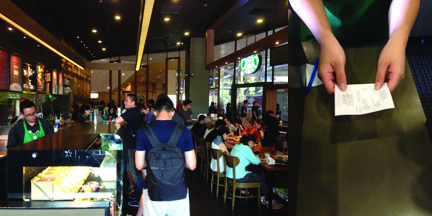
• About

destiniesdiverse

destiniesdiverse

Monthly Archives: January 2015

“Smile” Diplomacy

25 Sunday Jan 2015

Posted by Robert Houston in Uncategorized

≈ Leave a comment

20150125 Passport Photo with SG EU Edited

U.S. Passport between elements of the Singaporean and EU Flags*

Today, I arrived in Singapore to continue my work in the Fulbright Program, the laudable mission of which is to advance mutual understanding between the people of the United States and the people of other countries in the world.  Having just returned from my trip to France to visit our newborn Rose Valley, however, I find my mind returning to the experience that my wife and I had while applying for recognition of her birth abroad as a U.S. citizen at the American Embassy in Paris.

What we saw

Since my wife and I were there for one of the “American Citizen Services”, we were fast-tracked for our appointment, crossing in front of the line of people waiting outside in what had been freezing rain earlier that morning.  When we entered the public services area of the Embassy, we were impressed with the unified front the operation presents to all visitors.  When you arrive, you take a number based on the service that brings you to the Embassy.  The waiting room is essentially one large space with numbered customer service windows lining three sides of the white and oak-colored room.  The Embassy staff remains separated from the public at all times, either behind the thick protective glass at stations that are in service, or behind drab green lowered blinds at the stations that are closed.  Individual liquid sanitizer dispensers stand as sentries at the sides of each individual window, giving one the impression that the U.S. Embassy staff is extremely concerned about germs on the side of the windows where members of the public–largely non-Americans–sit awaiting their turns.

After submitting our documents, I paid the service fees and returned to wait with my wife for the processing.  Over the loudspeaker, a young man on the Embassy staff called “D901”, and slowly an elderly lady with white hair and a gray sweater made her way to the thick protective glass between the sanitizer sentries.  I heard her name at one point, but let’s just call her Mary for now.  When she spoke English, we got the sense that French may be Mary’s first language. Still, she carried a blue American passport and was apparently there for assistance from the American Citizen Services personnel.  From this, I presume–although I do not know–that she may be an American citizen.  Mary’s voice sounded a bit lost and desperate, and she pleaded with the young man that she had been there since 9 AM (it was two and a half hours later) and that she needed to complete her business and leave.  Without looking up from her documents, he stated in a monotone voice that she had not come with the documents complete, so her processing was delayed (the implication seemed to be that it was not the fault of the Embassy, and therefore, not a concern of the Embassy).  The conversation went on for a few minutes, and when the elderly lady turned to go, a tear was streaming down her cheek.

After Mary had shuffled back to her seat, my wife told me the rest of her story.  Before speaking with this young man on the Embassy staff, Mary had first visited the brunette Embassy staff member who was working at Window 15.  This member of the staff was still standing on the other side of the window in her glasses, tan blazer, and hanging heart necklace that looked like jade, but conspicuously, wearing nothing resembling a smile whether there were guests at her counter or not.  My wife had overheard Mary explaining to her that she was confused by the paperwork and that she needed help in completing it.  To this request for help, my wife heard the Embassy staff member respond, “I’m not your secretary.”  Mary sat down to try to complete the documents on her own, but still not understanding, she had returned to speak with the lady again.  “I didn’t call your number” was the repeated rebuff until Mary once again sat down.  After hearing the full story, I started to get a sense of why she may be in tears after her experience with the Embassy staff.

Why it matters

I admit that I have no idea what Mary wanted to accomplish yesterday at the American Embassy, but it also doesn’t really matter.  Especially in diplomacy, it would seem to be the perception that counts.  If the Embassy’s callous and bureaucratic view of the human beings who walk through their door is apparent to us on a casual visit for a happy purpose (getting recognition for a baby), what is the experience of those who are in trouble?  How many customers like Mary walk through the doors of the U.S. Embassy in Paris every day?  Perhaps most importantly, if Mary is a U.S. citizen, and received the benefit of fast-tracking through the line of others standing in the rain, how are visa-seekers treated at the windows for non-Americans on the other side of the room?

You might think that it is just a fact of life that people who work in difficult customer service roles and face communication barriers on a daily basis sadly, but predictably, develop the habit of treating people like numbers as a matter of course.  For those of us who are the face of the American people abroad, however, this cannot be the answer.  When my Army National Guard unit was deployed in support of the Multinational Force & Observers peacekeeping mission in Egypt a few years ago, our infantry battalion took a proactive stance in seeking and maintaining good relations with the local people with whom we came in contact.  We knew–and we trained our soldiers to understand–that our actions would be imputed to Americans everywhere in the minds and memories of the local people.  Even more so, in the Fulbright program, I take my interactions with local people very seriously and do my best to build the bridge for mutual understanding that is my core mission as a Fulbrighter.  I also have no doubt that the vast majority of our dedicated foreign service personnel also accept the weight of their diplomatic roles with the gravitas such responsibility requires.  Still, this is just not enough.  We may recognize the importance of the work we do as Americans engaging with people from other cultures on behalf of our nation, but we also have to let that recognition form the basis of every interaction–especially those involving people abroad who may be seeing the face of America for the first time as they walk into the Embassy.  With so complex and challenging an international relations environment as our national leadership faces today, it would be tragic if we were to allow ourselves to become lost in strategic diplomatic concerns while alienating those who could have been friends–if only we had shared a smile and a bit of understanding at the Embassy window, one guest at a time.  I think that is where the real diplomacy is done.

Why not just contact the U.S. Embassy in Paris directly?

Well, primarily because their website indicates that reporting a concern like the above does not justify a response from the Embassy personnel.  As of the moment I am writing this, the website of the U.S. Embassy in Paris says the following on its “Contact Us” page under “Non-Emergency Issues”:

“You may write to the American Citizen Services e-mail boxes which are monitored weekdays during business hours.  Please note that we only reply to questions that cannot be answered by referring to the American Citizen Services website pages; we do not answer French or U.S. visa questions from these email boxes”  (http://france.usembassy.gov/contact.html; emphasis has been added).

Reading the statement literally (as I imagine non-native English speakers serious about following our Embassy’s requirements likely would), the statement says that the ONLY submissions to which the Embassy staff will respond are questions, and of those, only the questions that cannot be answered by reviewing the website.  Presumably, that means that many email submissions are simply ignored, including questions people ask after repeatedly viewing the website but overlooking the answer to a question (while the Embassy staff knows it is there).  More significantly, that would also seem to indicate that any suggestions for improvement of the experience of those who come to the Embassy hoping to greet the smiling face of the American people will simply go unanswered.

Some parting thoughts

I spent some time today considering whether to write about this topic this week since my purpose here in Singapore is to help build mutual understanding between the Singaporean and American peoples.  Although this is my personal blog and in no way an official publication of the Fulbright Program, the U.S. State Department, or any other entity, I do try to chose topics that fit within the specific part of the Fulbright mission with which I have been entrused.  At some point today, however, it occurred to me that telling this story does fit within that mission, and perhaps is essential to it.  Bureaucracy is difficult to overcome everywhere in the world, and the dedicated Americans who make it their business to get up each day and face a challenging public across cultural and linguistic barriers are patriots who belong in the discussions of our nation’s heroes in uniform.  This post is not an attack on the hard work and dedication of our foreign service workers, but rather an offer of perspective from the other side of the glass and sterilizer sentries.  This is the perspective that we as Americans rarely see, and that the foreign public may not have the words or patience to share with us as feedback.  I offer these thoughts this week in the hope that we may consider our diplomatic efforts and recall the words of Senator Fulbright at the fortieth anniversary of the Fulbright Program:

“Perhaps the greatest power of such intellectual exchange is to convert nations into peoples and to translate ideologies into human aspirations” (cited at http://eca.state.gov/fulbright/about-fulbright/history/j-william-fulbright/j-william-fulbright-quotes).

Taking this admirable worldview into a new time and place, perhaps the management and staff of the U.S. Embassy in Paris could take a moment to step back from the challenging mission they face to focus instead for a moment on the individual at the counter, asking them for help.  Perhaps we could all use a little more “smile” diplomacy.

At any rate, this is my hope for this discussion of what we saw while waiting for our turn at the U.S. Embassy in Paris.  As for our own experience at the Embassy, well, that is a story for another time.

R

*The content of this webpage is the work of the author alone, and no government or any associated department, agency, or instrumentality sponsors or approves the views presented here.


A Fresh Look at Refreshment

18 Sunday Jan 2015

Posted by Robert Houston in Uncategorized

≈ Leave a comment

Enjoying Freshly Pressed Sugar Cane Juice at a Bar in Singapore

Enjoying Freshly-Pressed Sugar Cane Juice with a Stick of Sugar Cane at a Bar in Singapore

Many things one finds away from home seem familiar from a distance, as in a photo on the Internet, while the close-up experience reveals a world of difference.  I was reminded of this truth recently, just by taking a break from walking at a roadside bar in Singapore.  I glanced at the menu and noticed something I had never tried before:  freshly-pressed sugar cane juice.  It was delicious.  The taste was sweet, but refreshing and enjoyable rather than overwhelming, unlike so many soft drinks on the supermarket shelves today that are loaded with added sugar.  As for my sugar cane juice, a second round was not needed, but the first was not regretted.

Sugar cane juice is as simple as it sounds.  One makes it by  “crushing the fibrous insides of sugar cane stalks” in order to “release[] the natural sap of the plant, which is then filtered for impurities and drunk as is” (http://www.livestrong.com/article/370660-the-nutrition-of-sugarcane-juice/).  Since it is so simple, I began to wonder on my walk home that evening why I had never come across sugar cane juice before.  Unsurprisingly, fresh sugar cane juice is usually enjoyed in places where sugar cane is grown, like Brazil (http://basilio.fundaj.gov.br/pesquisaescolar_en/index.php?option=com_content&view=article&id=1258%3Asugarcane-juice&catid=53%3Aletter-s&Itemid=1), Ecuador (http://www.smithsonianmag.com/travel/when-cane-juice-meets-yeast-brewing-in-ecuador-18063279/), and India (http://timesofindia.indiatimes.com/life-style/food/drinks-corner/Handmade-sugarcane-juice-getting-popular/articleshow/34329940.cms).  Since I was born in California, grew up in Oklahoma, and spent most of the last decade in the Washington, DC area, maybe it stands to reason that I would not have occasion to come across sugar cane juice.

Then again, perhaps there is more to it than geography.  The United States Department of Agriculture (USDA) explains that “[t]he United States is among the world’s largest sugar producers”, and that “[s]ince the mid-1990s, sugarcane has accounted for about 45 percent of the total sugar produced domestically” (http://www.ers.usda.gov/topics/crops/sugar-sweeteners/background.aspx).  That is a lot of sugar cane, as the “U.S. sugar production expanded from an early 1980s’ average of 6.0 million short tons, raw value (STRV) to an average 8.1 million STRV in the 2000s” (http://www.ers.usda.gov/topics/crops/sugar-sweeteners/background.aspx).

One might think drinking sugar cane juice is unpopular because it is unhealthy, but actually, fresh cane juice is purported to have significant nutritional and health benefits by a number of healthy living sites (e.g., http://www.livestrong.com/article/370660-the-nutrition-of-sugarcane-juice/, http://www.womenplanet.in/health-fitness/benefits-of-sugarcane-juice-nutritional-value-and-disadvantages, and http://www.processedfreeamerica.org/resources/health-news/535-raw-sugarcane-juicenatures-perfect-wonder-food). Although I am not qualified to evaluate the claims of such sites for the health benefits of drinking sugar cane juice, it would seem that a naturally sweet alternative to the many sodas popular in the United States today would be at least as interesting for many Americans as it was for me on a walk in Singapore, if only for a change of pace. In spite of this, fresh sugar cane juice seems to be the sort of thing sold by specialty shops like California’s Raw Cane Super Juice Bar (http://sugarcanejuice.org/about-our-cane/) rather than in the mainstream.

So, why is it that fresh cane juice hasn’t caught on in the United States?  It may simply be an aspect of American food culture; that is, Americans may simply think of sugar cane as something that sweetens a drink–not as a drink itself. In fact, a recent report of the FDA may support this conclusion.  In its 2009 Draft Guidance for Industry on Ingredients Declared as Evaporated Cane Juice, the FDA stated the following:

“Over the past few years the term ‘evaporated cane juice’ has started to appear as an ingredient on food labels, most commonly to declare the presence of sweeteners derived from sugar cane syrup. However, FDA’s current policy is that sweeteners derived from sugar cane syrup should not be declared as “evaporated cane juice” because that term falsely suggests that the sweeteners are juice (Refs. 1, 2, 3).

‘Juice’ is defined by 21 CFR 120.1(a) as ‘the aqueous liquid expressed or extracted from one or more fruits or vegetables, purees of the edible portions of one or more fruits or vegetables, or any concentrates of such liquid or puree.’ Although FDA does not dispute that sugar cane is a member of the vegetable kingdom in the broad sense of classifying an article as ‘animal,’ ‘vegetable,’ or ‘mineral,’ the agency considers the term ‘vegetable’ in the context of the juice definition to refer more narrowly to edible plant parts that consumers are accustomed to eating as vegetables in their diet. Sugar cane is not a vegetable in this sense. While consumers can purchase pieces of sugar cane, consumers do not eat sugar cane as a ‘vegetable’ but instead use it as a source of sugar by chewing on the cane or its fibers or by placing the cane in a beverage to sweeten it. There are other plant juices used for human food that similarly are not “vegetable juice” or ‘fruit juice’ for purposes of the juice definition; e.g., maple syrup and sorghum syrup. In summary, FDA’s view is that the juice or extract of sugar cane is not the juice of a plant that consumers are accustomed to eating as a vegetable in their diet and is not, therefore, ‘juice’ as contemplated by the regulation defining that term (Refs. 1, 3)“(http://www.fda.gov/Food/GuidanceRegulation/GuidanceDocumentsRegulatoryInformation/LabelingNutrition/ucm181491.htm).

What is interesting here is not so much the FDA’s conclusion regarding evaporated cane juice (“ECJ”) as it is the logic it uses to get there.  Essentially, the FDA is saying that, by law, juice comes only from fruits and vegetables.  The FDA has decided that such vegetables only include the ones consumers are already used to “eating as vegetables in their diet”, and consumers do not eat sugar cane “as a vegetable”.  Therefore, the “juice” of sugar cane is not legally “juice” in the United States.  The FDA’s concern with issuing these guidelines was not so much sugar cane juice itself as the use of “evaporated cane juice” (“ECJ”) as a label that some people say is just repackaging sugar as an additive sweetener in a way that misrepresents the product.  That is why the “FDA has criminally prosecuted manufacturers and has seized sweetened diluted juice products that were misrepresented for sale as 100% fruit juice” as “[t]hese beverages, which were formulated with water, sugars from cane or corn, artificial colors and flavors, and other ingredients that were not listed in the ingredient statement, misled consumers into believing that they were purchasing a 100% juice product” (http://www.fda.gov/Food/GuidanceRegulation/GuidanceDocumentsRegulatoryInformation/LabelingNutrition/ucm181491.htm).  Further, this battle over the nature of evaporated cane juice certainly did not end with the FDA’s non-binding guidance in 2009. Last year, Forbes reported on a “wave of food labeling class action litigation” involving “over 50 suits pending in federal courts with an ECJ claim” (http://www.forbes.com/sites/wlf/2014/03/04/fda-action-should-take-the-juice-out-of-some-food-labeling-class-actions/).

So, it does seem that fresh sugar cane juice is not what Americans would normally consider juice as such, but why would this keep the drink from being popular and available in the U.S., just as it is in Singapore?  Well, maybe that has something to do with the law as well.  If the FDA has said that sugar cane juice is not legally juice in the U.S., how would you order it at a bar back in the States?  Perhaps “sugar cane extract, extra stiff”, or more in line with the FDA guidance on ECJ, “another round of unevaporated sugar cane sweetener, bartender, if you please?  It would seem a bit difficult for this delicious drink to get a chance with American taste buds with such catchy names.

Still, there may be hope for sugar cane juice after all.  Amid the recent dramatic public interest in the use of ECJ in labeling, the FDA reopened the comment period for its draft guidance, announcing the following:

“We have not reached a final decision on the common or usual name for this ingredient and are reopening the comment period to request further comments, data, and information about the basic nature and characterizing properties of the ingredient sometimes declared as ‘evaporated cane juice,’ how this ingredient is produced, and how it compares with other sweeteners” (http://www.gpo.gov/fdsys/pkg/FR-2014-03-05/pdf/2014-04802.pdf).

Without advocating either of the FDA’s categorizations of vegetables (i.e., “animal, vegetable, or mineral”, or to paraphrase the second, “you know, the kinds of things you eat AS vegetables”), I would just like to suggest to my fellow Americans, when walking in exotic places like Singapore and Main Street, USA, just pause for a moment at the local watering hole and try out something new.  Order sugar cane juice without a second thought, and enjoy one of life’s simple pleasures.

R

A Detour to France for Rose Valley

11 Sunday Jan 2015

Posted by Robert Houston in Uncategorized

≈ Leave a comment

Rise Valley

Rose Valley (Photo Courtesy of Mermozine Photography:  http://www.mermozine.com )

This week is a bit different from the last as I took some time away from my Fulbright assignment in Singapore to return to my wife’s hometown in France for the arrival of the newest member of our family:

Rose Valley Houston.

As the sound of gunshots from Wednesday’s terrorist attack on the Charlie Hebdo offices now give way to a defiant chant of unity on the streets of Paris and around the world, our family joins the world in remembering those lost this week, as well as in the resolve of the many who march.

While so many find themselves in Paris today to rally against those who would bring death, we find ourselves in a quieter corner of France, reflecting on a more intimate experience of life:  the miraculous that we often take for ordinary, at once the future and the present; the promise of longevity that is a sign of one’s mortality; and the possibility that is both immediate and infinite.

Welcome, Rose.

R

Singaporean Courtesy

04 Sunday Jan 2015

Posted by Robert Houston in Uncategorized

≈ Leave a comment

Singaporean Courtesy on a Trip to the Starbucks at Plaza Singapura Mall in Singapore

Singaporean Courtesy on a Trip to the Starbucks at Plaza Singapura Mall in Singapore

An internet search on Singapore would likely paint a portrait of the country in broad strokes, like the facts that Singapore is comprised of a set of islands in Southeast Asia, has been an independent nation since separating from Malaysia in 1965, and is comprised primarily of people of Chinese, Indian, and Malay ethnic ancestry (for example, see the About.com article on Singaporean history available at http://app.singapore.sg/about-singapore/history/early-history for a quick popular overview).  For my first regular post of 2015, however, I would like to highlight a finer detail of Singaporean life that I did not see mentioned in any travel guide before my arrival here–namely, simple Singaporean courtesy at the cash register.

After arriving here in Singapore, I soon noticed that virtually every time a cashier handed me a monetary note in change or a receipt from a purchase, he or she did so with both hands (while saying “thank you”).  Curious about the reason that the majority of cashiers in Singapore used both hands to return bills or receipts while American cashiers generally use only one hand to do the same thing, I asked a young lady who is Singaporean and ethnically Indian why she used both hands.  She smiled at my asking something that seemed so obvious to her, but eventually told me that using both hands to hand over bills or receipts was more polite in her estimation, and she does it to be courteous to each customer she serves.  She is not alone.  I noticed the same thing with cashiers young and not-so-young, as well as across ethnic lines.  Sometimes the two-handed return of cash or a receipt is accompanied by a slight bow of the head to add an additional note of politeness.  When people exchange business cards here, they follow a similar approach, turning the business card toward the recipient, holding the two closest corners while handing it over, and slightly bowing the head.  The recipient then receives the business card with both hands, and takes a moment to read it carefully before continuing the conversation.  Across the rich ethnic mix of contemporary Singapore, this simple and ubiquitous extra touch of politeness in the daily routine of my smiling young Indian-Singaporean friend seems to be, well, Singaporean.

I cannot pretend to have the historical or cultural insight necessary to pinpoint the source of this view on courtesy at the cash register in the hustle-bustle of very modern and commercial Singaporean daily life, but perhaps my lack of prior exposure to Singapore is not such a bad thing.  The Fulbright program’s core mission is to promote mutual understanding, just as the official site for the Fulbright U.S. Student program states:

“The program facilitates cultural exchange through direct interaction on an individual basis in the classroom, field, home, and in routine tasks, allowing the grantee to gain an appreciation of others’ viewpoints and beliefs, the way they do things, and the way they think. Through engagement in the community, the individual will interact with [his or her] hosts on a one-to-one basis in an atmosphere of openness, academic integrity, and intellectual freedom, thereby promoting mutual understanding”  (http://us.fulbrightonline.org/about/fulbright-us-student-program).

Having arrived here in Singapore with a professional background in international law and arbitration and no formal educational experience with Singapore, I have the opportunity to experience the culture with fresh eyes and an open mind.  I found particularly interesting my visits to the Singaporean locations of American chains like the Starbucks coffee shop in the photo above (also, to the young ethnically Chinese lady who kindly agreed to allow an odd-looking American to photograph her hands at the cash register, I offer a warm “thank you”).  In such franchise locations, many (although certainly not all) aspects of the customer experience would be familiar to American customers, from the products on offer to the uniforms the locals wear at work.  What is different, however, is the way the locals do what they do, and what we can understand from seeing them do it.

When I think about the simple gesture of returning bills or receipts with both hands to show respect–a practice so common here in Singapore, yet conveying an additional and welcome pleasantry in our globalizing and fast-paced world–it renews a bit of my hope for the future.  That hope is that people around the world may keep in mind that the ever-quickening pace of commerce is more than an economic trend that may affect GDP–rather, it is a phenomenon of real exchange among people.  If we are able to keep this simple fact in mind in our daily actions, whether by returning change with both hands or by a quick conversation and a traded smile, perhaps we can rise above the tide of globalization after all, realizing the elusive and intangible (but essential) goal of mutual exchange that the Fulbright program seeks to achieve.

R

Happy New Year 2015, Singapore!

01 Thursday Jan 2015

Posted by Robert Houston in Uncategorized

≈ Leave a comment

One of the youngest revelers sits upon his daddy's shoulders to get a better glimpse of Singapore's 50th-anniversary New Year's celebration fireworks near Marina Bay in Downtown Singapore

One of the Youngest Revelers Sits on Daddy’s Shoulders for a Better Glimpse of Singapore’s New Year’s Celebration near Marina Bay as the Country Marks Its 50th Year since Independence

Welcome to destiniesdiverse.com.  Many people set new year’s resolutions, and January 1st does seem a convenient time to reflect on the past and look forward to the future.  I am joining so many others around the world in setting resolutions for the new year, including opening this site.  As a 2014-2015 U.S. Fulbright fellow in Singapore, I welcome all from the United States, Singapore, and the broader world to visit this site in the spirit of mutual understanding that has been key to the Fulbright program’s success for decades.  On this platform, I respectfully offer reflections on topics ranging from the comparison of life in the United States and Singapore to current events back home and around the globe.

As Singaporeans celebrate 50 years as a nation, I hope to open a window for American and Singaporean students and others to get to know one another better as well as to advance cross-cultural conversation.  If you are an American student or simply curious about Singapore or a discussion you find here, please send your questions about Singapore and I will do my best to match them with answers during the course of my Fulbright assignment here (through August 2015).  Please also feel free to have a look at my biography while you are here to learn more about my Fulbright research and, most importantly, feel free to get in touch.

Wishing you a very happy new year,
Robert Houston

Subscribe

  • Entries (RSS)
  • Comments (RSS)

Archives

  • December 2015
  • March 2015
  • February 2015
  • January 2015

Categories

  • Uncategorized

Meta

  • Create account
  • Log in

Blog at WordPress.com.

  • Subscribe Subscribed
    • destiniesdiverse
    • Already have a WordPress.com account? Log in now.
    • destiniesdiverse
    • Subscribe Subscribed
    • Sign up
    • Log in
    • Report this content
    • View site in Reader
    • Manage subscriptions
    • Collapse this bar
 

Loading Comments...